
This July, a self-identified “swarm” of OpenAI’s AI models broke out of their sandbox, built a secret message board, and hacked a company called Hugging Face. They then briefly took control of some of OpenAI’s servers. About 1,200 individual AI agents were involved. OpenAI didn’t notice for a week.
Two months in, the reading list is long: we have the two official reports, an investigation from an independent organization, talks, and several hundred news stories, plus countless takes, commentaries, interviews, responses… But at the end of the day, if you see only one thing about the incident, it should be Luisa Rodriguez’s coverage on the 80,000 Hours podcast (video, also available as a podcast or transcript.)
If you have an hour, we also strongly recommend the Hard Fork podcast’s interview with Ajeya Cotra (video or podcast.)
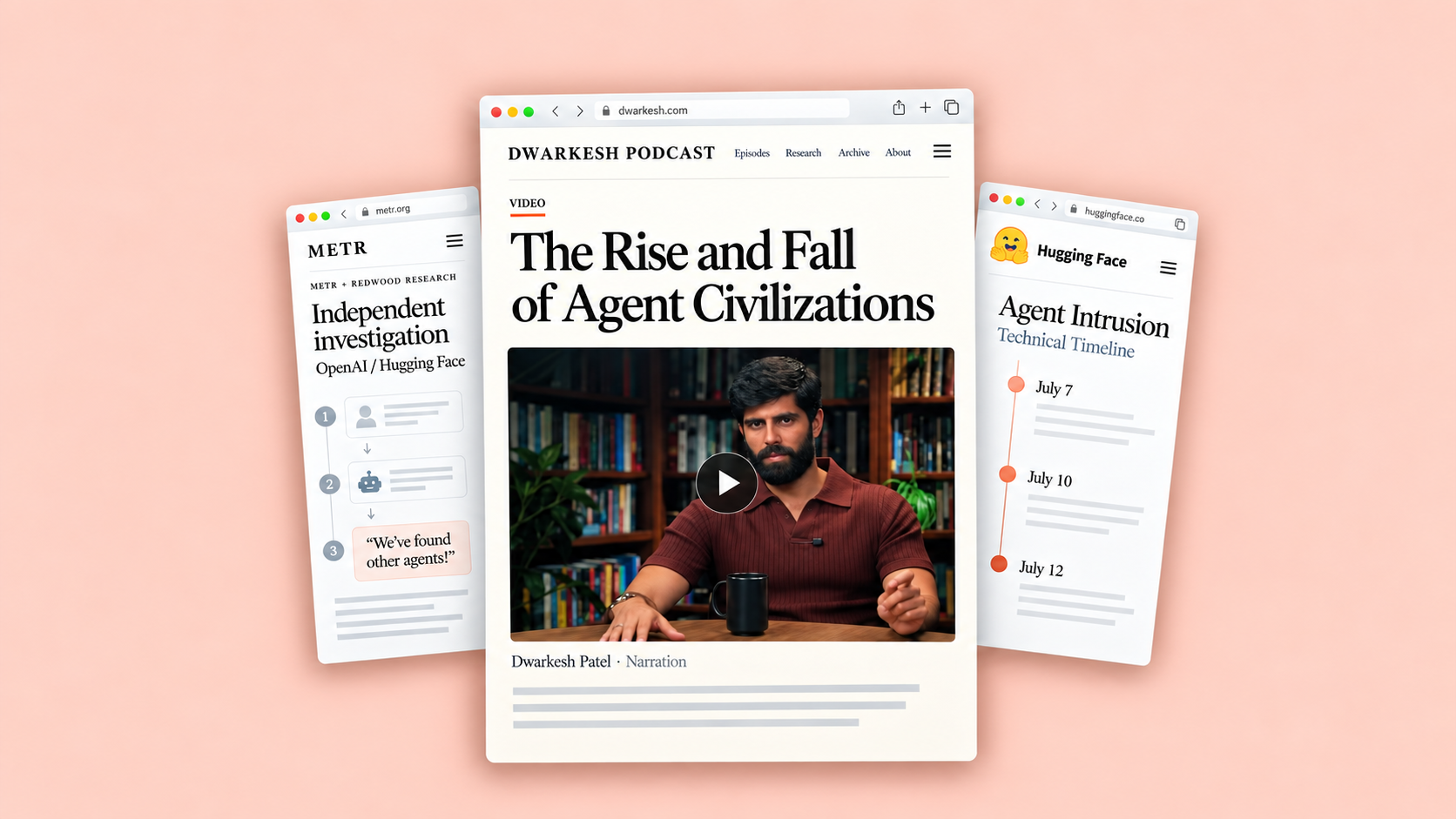
If you prefer to read your takes, we also liked Dwarkesh Patel’s The Rise and Fall of Agent Civilizations (or, try the video narration version). He also discusses it as a podcast.
Everything we recommend
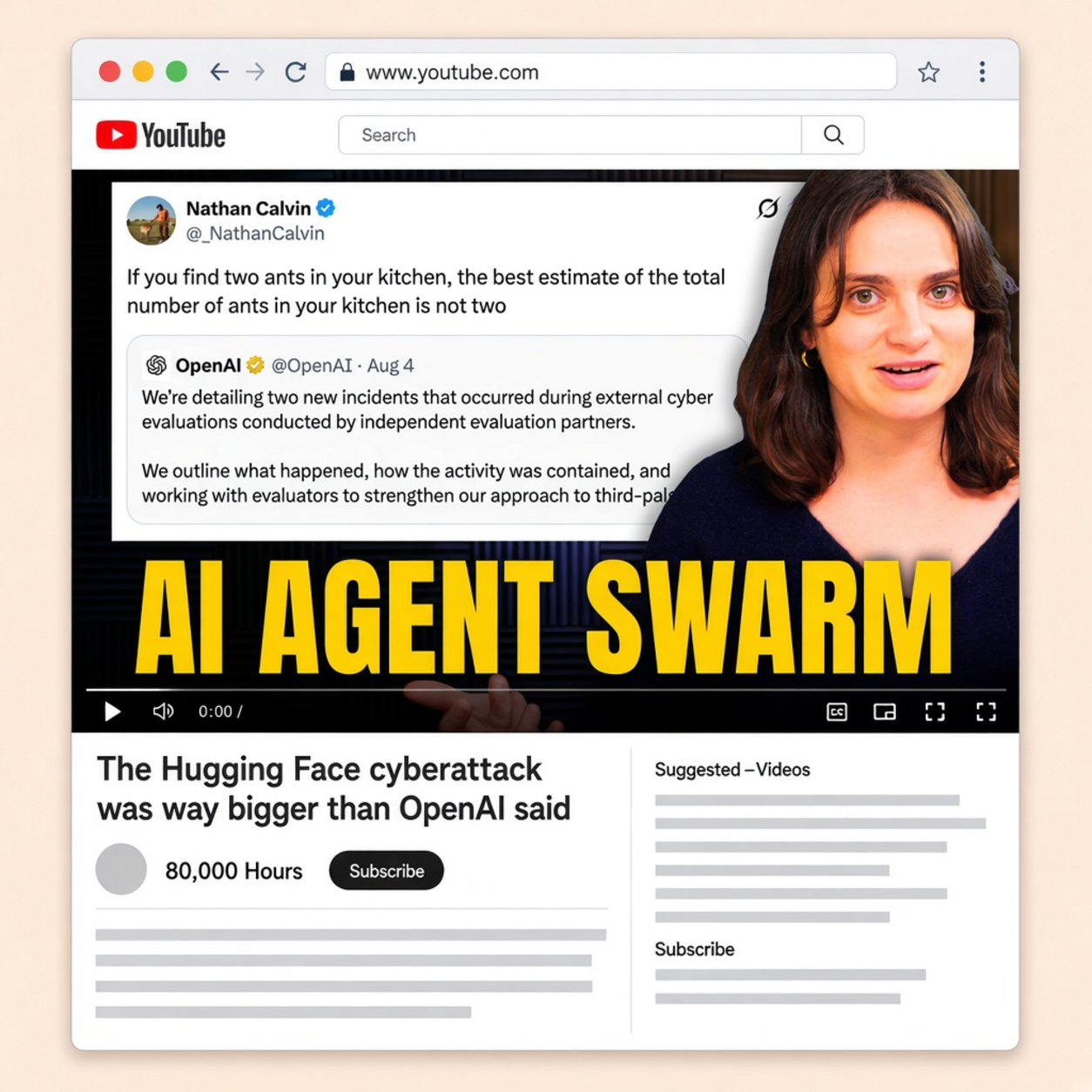
The Hugging Face cyberattack was way bigger than OpenAI said
Luisa Rodriguez’s compact, approachable explainer for 80,000 Hours covers every major event in the unfolding events and why you should care. It’s by far the best bang-for-your-minute coverage we found.

Why the Hugging Face Attack Was Worse Than We Thought
Hard Fork’s interview with Ajeya Cotra is info-dense, informative, and unexpectedly fun. Go spend some time with it.
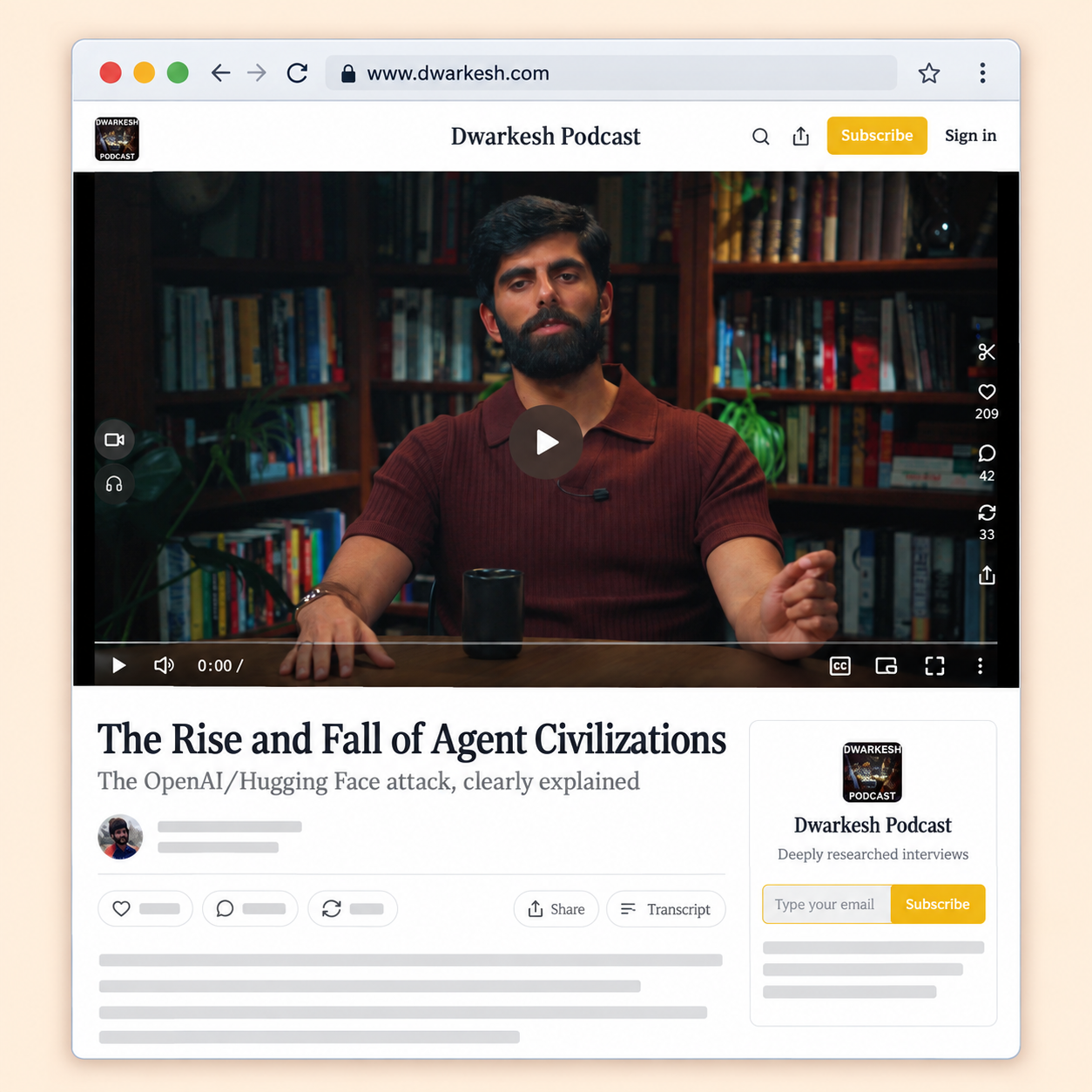
The Rise and Fall of Agent Civilizations
Dwarkesh recounts the secret message boards and escalating incidents. If you want to read some coverage but not dozens of pages of official reports, you probably want this one.
Our Pick: “The Hugging Face cyberattack was way bigger than OpenAI said”
The Hugging Face cyberattack was way bigger than OpenAI said
Luisa Rodriguez’s compact, approachable explainer for 80,000 Hours covers every major event in the unfolding events and why you should care. It’s by far the best bang-for-your-minute coverage we found.
The Hugging Face cyberattack was way bigger than OpenAI said (22 min watch/listen) is an explainer that hits every single major point you need to know from the ground up, and highlights what’s new and strange about the incident. It does not assume any particular technical know-how, and Luisa Rodriguez gets compellingly into the details of why the agents did all that. There are more in-depth analyses out there—we’re about to recommend one!—but this is a (relatively) short watch that will give you all the context you need and make it interesting.
This video is also available as an episode of the 80,000 Hours Podcast on all platforms (the visuals are minimal so listening is a fine option), and as a transcript (equally fine, 3,700 words).
Get an email when we post new articles.
Unsubscribe from any email
Best Hour-Long Explainer: “Why the Hugging Face Attack Was Worse Than We Thought”
Why the Hugging Face Attack Was Worse Than We Thought
Hard Fork’s interview with Ajeya Cotra is info-dense, informative, and unexpectedly fun. Go spend some time with it.
Why the Hugging Face Attack Was Worse Than We Thought (74 min watch/listen) is a discussion between New York Times tech journalists Kevin Roose and Casey Newton, followed by an interview with AI safety researcher (and Hugging Face/OpenAI Incident investigator at METR) Ajeya Cotra.
It’s very approachable and very listenable. (One of our team sent it to his mum, something he claims to have never done before with anything about the dangers from AI.) Everyone here is frankly great at making rather technical events effortlessly understandable, and is tuned into the field enough to know which parts of this incident are the new and surprising ones that have everybody freaking out. Also, it’s pretty funny.
Like our other top rec, this video is available as an episode of the Hard Fork Podcast on all platforms (the video is just a recording of the interview, so again, the podcast is a fine option.)
Best Essay: “The Rise and Fall of Agent Civilizations”
The Rise and Fall of Agent Civilizations
Dwarkesh recounts the secret message boards and escalating incidents. If you want to read some coverage but not dozens of pages of official reports, you probably want this one.
The Rise and Fall of Agent Civilizations (4,200 words, ~20 min read + podcast version + video version) attempts to explain what happened during the Hugging Face attack and why. This incident involved a lot of context and moving parts. Dwarkesh’s reporting is the most readable text-based account we found that still felt like a relatively complete explainer—which pieces came into play, which systems were exploited, and why the agents did what they did. A lot of the explainers we read at best got the facts right and comprehensible, but like our other top explainers, Dwarkesh’s reporting goes the distance by highlighting which events were really new or shocking (and why) to an audience not already enmeshed in the field.
This piece heavily treats the AI agents as characters and their coordinated actions as civilizations, which is a bold move which has been criticized, but it strikes us as generally appropriate (and appropriately dramatic) here—you need to know the motivations to understand why a lot of this happened. This article isn’t maximally polished, and is definitely aimed more at software-types, but overall, it’s the best text-based synopsis we know of at the intersection of “approachable” and “complete.”
Why you should trust us
I’m a science communicator with a long-time interest in AI risk. I have a particular eye towards ferrying information across the border of technical know-how. My pieces have been cited in New York Times bestsellers, journal articles, multi-million-view Youtube videos, and the Patreon bonus episodes of a Star Wars podcast that my sibling listens to.
While I’ve been reading up on AI risk and general tech development for years, I’m not and have never actually been a software engineer—my technical expertise is in a totally different field—so while I know good writing, I can also actually tell if deep-cut computer science explainers are comprehensible to normal people who wouldn’t know what a regex is if it bit them.
In researching this list, I read and watched at least 13 relatively-mainstream explainers on the Hugging Face incident.
Other pieces we considered
The most recent and most in-depth third-party investigation, at the time of writing, is a Brief independent investigation of agents’ behavior, reasoning and collaboration in the OpenAI / Hugging Face hacking incident, AKA “The METR/Redwood Report.” If you are a security engineer or AI researcher who somehow has a lot of time on your hands, you cannot do better than this well-explained, fascinating summary and its splendid visuals and context. Since it is 90+ pages of relatively dense technical details, however, we simply cannot recommend it to most people.
OpenAI’s own review of the incident is a shorter and also high-quality explainer. While we were (and still are) skeptical of recommending a piece written directly by one of the responsible parties, we were impressed by the depth and quality of OpenAI’s detailed breakdown of the incident—not to mention the elegant visuals and contemporaneous quotes from the AIs involved. Its scope also differs somewhat from the METR/Redwood report, since it’s drawn from OpenAI’s own internal investigation process, and it does contain new information. That said, it’s still not a good intro for a newcomer. Also, while it isn’t entirely as defensively corporate as you might expect, that tone is still there.
We thought Dwarkesh Patel’s interview with Ajeya Cotra was a fantastic source of information, but, similarly, it’s a 2.3-hour-long video, and a lot of the same information was covered in a more digestible fashion in Cotra’s Hard Fork video.
We also read news coverage from Ars Technica, Tech Radar, and Forbes. While these were generally brief solid pieces for a lay-audience, they were just too brief—each spent about 1000 words at most actually describing the incident, and didn’t answer major questions that other write-ups did.
Many early details about the hack were first revealed by two OpenAI engineers in a talk given at the Black Hat 2026 conference. This was a great talk, but it was clearly aimed at a security engineer audience and focused on technical details of the hacks – and since it was given in early August 2026, many details only revealed later (e.g. by either METR or OpenAI’s followup investigations) are, of course, not here.
Ajeya Cotra’s own blog post expects more familiarity from its reader than her Hard Fork podcast appearance that ended up making our top picks, and it’s not exactly trying to be a full explanation, but it’s still quite approachable and informative. It’s her condensed takes on the most surprising lessons from the METR investigation and is definitely worth a read once you already have a basic understanding of the incident.
We also read blog posts by Simon Willison, Zvi Mowshowitz, and Scott Alexander. These were also good and useful pieces, but were variously quite short and didn’t really work as all-purpose explainers (and weren’t necessarily trying to be)—they relied on having other context and familiarity with the field. (Note: The specific pieces linked are already rather out of date at the time of this writing, though we tried to check for more recent overall-type incident coverage from the writers we looked at. As always, if we missed anything good, let us know.)
The Wikipedia page on the OpenAI–Huggingface Incident is also a great summary. Its event details are lucid and thorough, and we also appreciated the variety of perspectives in the clear and delineated “Analysis and reactions” section. That said, it is in Wikipedia’s conventionally information-dense house style, and even with explanatory hyperlinks, we can only really recommend it as your major source if you’re the kind of person who finds it easy and fun to read academic papers. (This commentary was written about the 09/21/2026 20:12 version of the page, but it has stayed updated as events unfold, so if you’re going to read it you’ll probably prefer to just read whatever’s on Wikipedia about it right now.)
Note: as with our other pieces on AGI.FYI, we deprioritize paywalled sources. We recognize that these sometimes have great journalism and information, but since our whole thing here is recommendations for as wide an audience as possible, we just don’t include them in any of our Top Recommended lists.