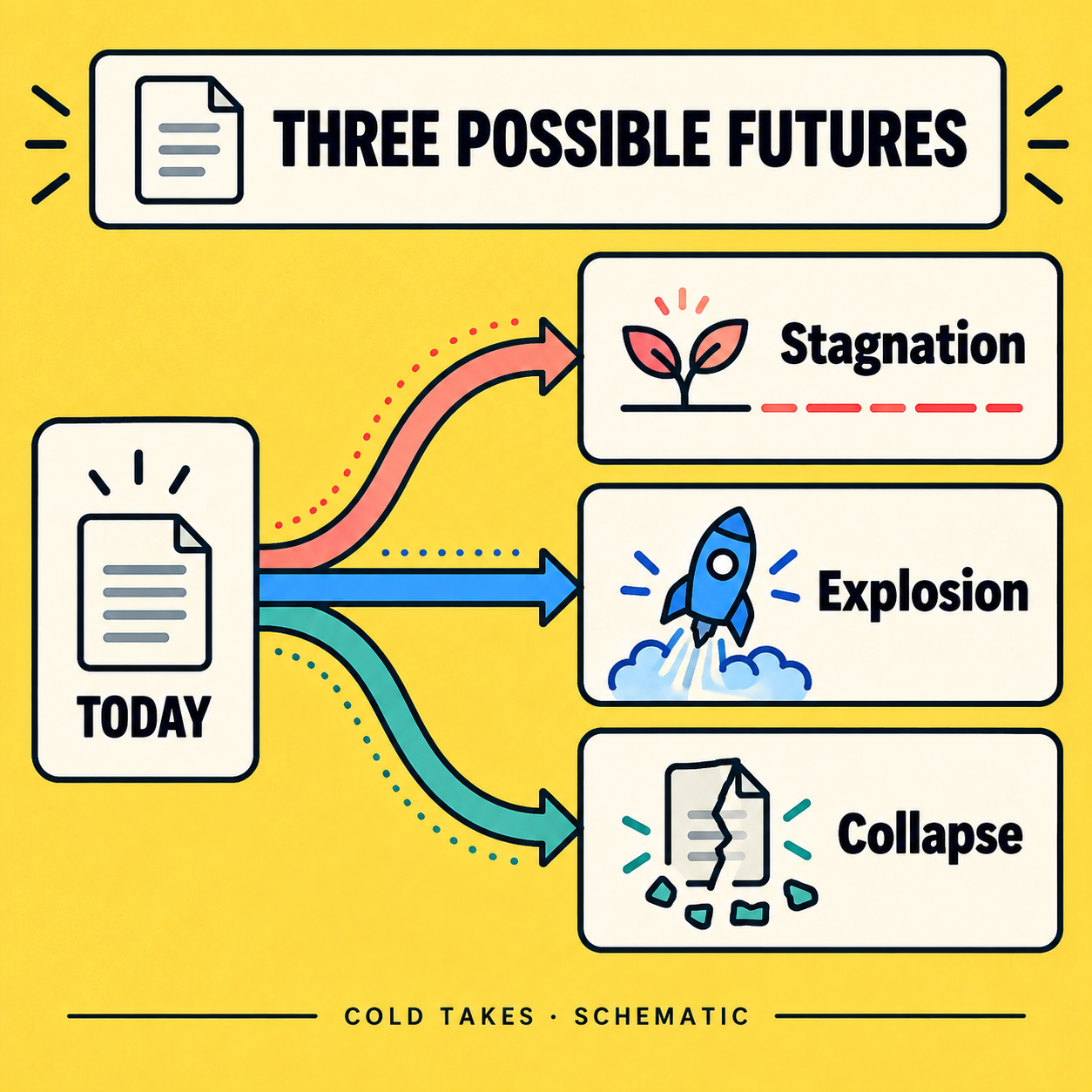
In the last five years, language models have gone from being unable to multiply two-digit numbers, to autonomously breaking out of their sandboxes and hacking into HuggingFace servers. What’s going to happen next? I’ve read many predictions and narratives for how the next few years could go.
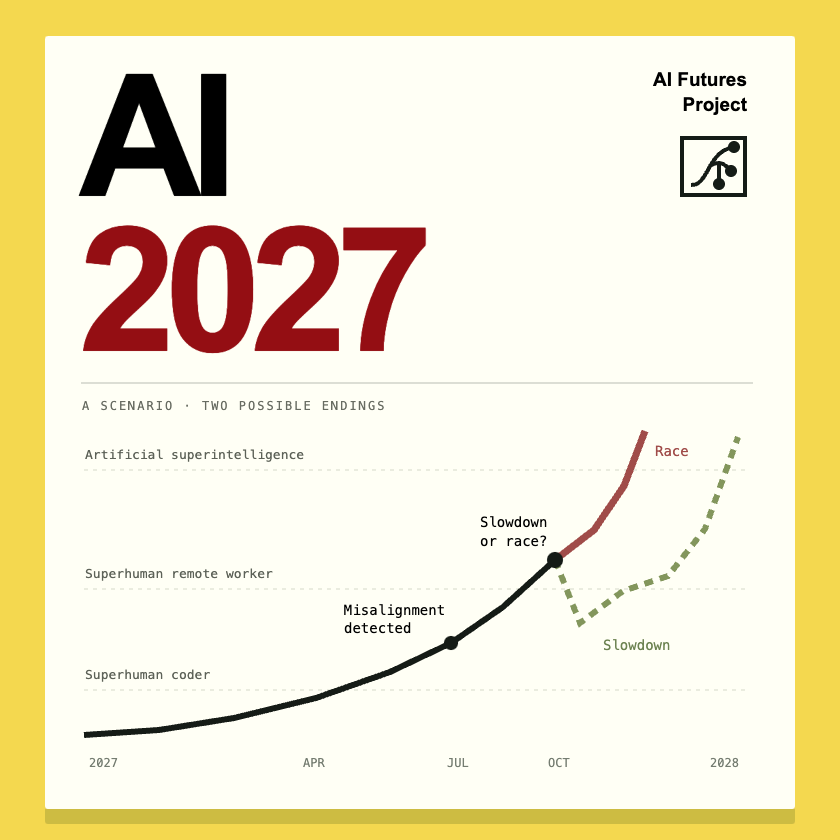
The standout read is AI 2027. The authors combine AI expertise and writing talent to tell a frightening story about AI displacing human jobs by 2027, and how it may end the human race by 2030. The authors’ timelines are a little longer than that, but they see this as a plausible future—unless we figure out how to build AI safely.
For a very different approach which looks at the problem purely scientifically without trying to tell a story, consider Task-Completion Time Horizons of Frontier AI Models. This report measures AI’s ability to complete tasks based on how long those tasks take. It finds that AI’s “attention spans” have been growing at an exponential pace since the launch of ChatGPT in 2022. This trend has continued since the article’s publication last year. As AI systems’ time horizons grow, the range of tasks they can complete will become ever larger.
Get an email when a guide is updated.
Picks change as better pieces appear. A confirmation link arrives first; unsubscribe from any email.
Everything we recommend
AI 2027
2025
The gold standard of AI scenarios. Written in 2025 by a diverse team of experts, AI 2027 depicts a possible future where AI capabilities advance shockingly rapidly, surpassing humans by 2028. The story has two endings: in the first, humanity wakes up barely in time to make the critical decisions to meet the existential challenge of superhuman AI, and maybe survives; in the second, the AIs gain control of the world economy, and then when humanity is no longer needed, the AIs get rid of us.
Read it ↗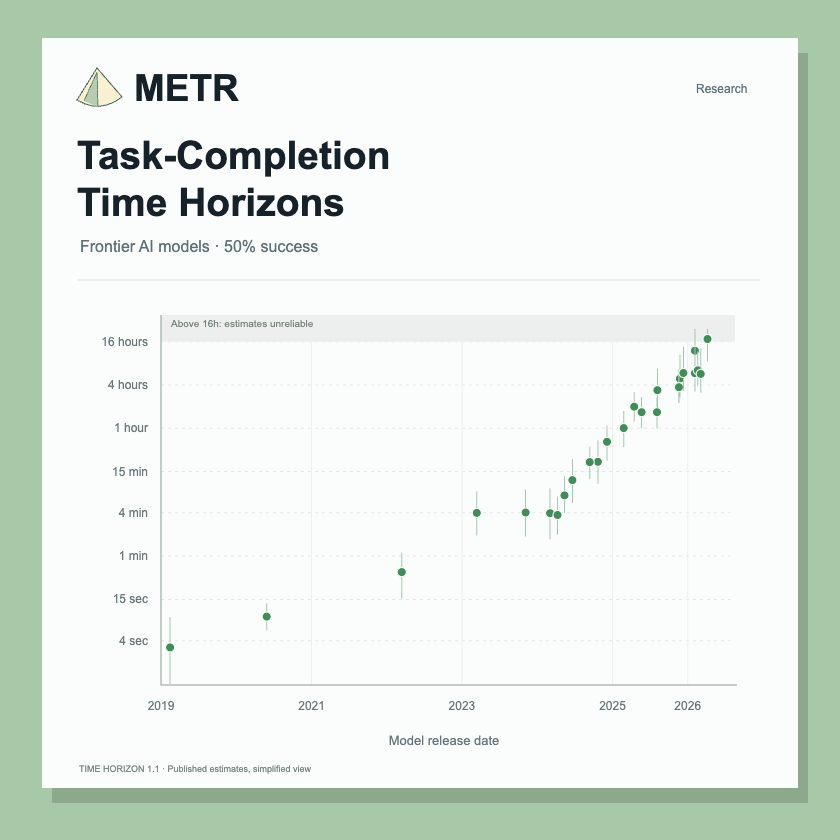
Task-Completion Time Horizons of Frontier AI Models
METR · 2025
A team at Model Evaluation & Threat Research (METR) finds that AI models are getting exponentially better at performing tasks with longer and longer time horizons, with the horizons doubling every 4–8 months. If the trend continues, it will only be a few more years before AI is good enough to displace most human labor.
Read it ↗Our top pick – AI 2027
AI 2027
2025
The gold standard of AI scenarios. Written in 2025 by a diverse team of experts, AI 2027 depicts a possible future where AI capabilities advance shockingly rapidly, surpassing humans by 2028. The story has two endings: in the first, humanity wakes up barely in time to make the critical decisions to meet the existential challenge of superhuman AI, and maybe survives; in the second, the AIs gain control of the world economy, and then when humanity is no longer needed, the AIs get rid of us.
Read it ↗Why it’s the standout choice
It’s written by the best team. AI 2027 is a dream-team collaboration between some of the best AI forecasters. Their team includes AI researcher Daniel Kokotajlo—who, in 2021, made bold predictions about the next five years of AI progress that turned out to be shockingly accurate; and who quit OpenAI in April 2024 after he became increasingly worried that OpenAI could not be trusted to build superhuman AI. The team also features Eli Lifland, an expert forecaster who holds the top rank on the RAND Forecasting Initiative all-time leaderboard.
It paints a clear picture. The team’s predictions take the form of a short story, describing two ways the next few years might play out. The final outcome is surprising—AI quickly overtaking humanity, and possibly eradicating us—but the authors connect the dots from each step to the next.
The scenario comes with boatloads of optional material to answer any lingering questions. The supplements go into detail about questions like: Why do the authors predict a 50% chance of human-level AI by 2028? What goals will AIs have? And since publication, the team has continued to write updates as things change—here’s their post from Q1 2026.
Flaws but not dealbreakers
The scenario is mostly linear, with only a single decision-point sending the future along one of two trajectories. There are many possible futures, and real life will certainly not look exactly like AI 2027. The authors’ 2026 follow-up, AI 2040, mitigates this by describing five different ways humanity might respond to the challenge of AI, and explaining the authors’ preferred plan.
It’s a forecast by a single team, not a diverse range of views. AI 2027 doesn’t give you a sense of the full spectrum of views held by AI experts. It’s just one possible future, as predicted by one group of people.
It’s long. Even ignoring the supplements and appendices, the narrative is over 15,000 words long.
Best data-driven forecast – METR time horizons
Task-Completion Time Horizons of Frontier AI Models
METR · 2025
A team at Model Evaluation & Threat Research (METR) finds that AI models are getting exponentially better at performing tasks with longer and longer time horizons, with the horizons doubling every 4–8 months. If the trend continues, it will only be a few more years before AI is good enough to displace most human labor.
Read it ↗Numeric forecasts are hard to do right. You have to find a question that’s straightforward enough that you can answer it with data, but not too narrow to be useful in real life.
The METR time horizon forecast, from the non-profit Model Evaluation & Threat Research (METR), is a data-driven forecast done right. The team looked at the history of AI capabilities, and matched them up with how long tasks take people to complete. “Answer a short question” takes 30 seconds; “Count words in a passage” takes a few minutes; “Find a fact on the web” takes 10 minutes.
Over time, AI models have been getting better at completing longer and longer tasks. A natural question to ask is, When will AI be able to replace human jobs? AI already surpasses human abilities on many short-term tasks, but humans maintain our monopoly on tasks that take weeks, months, or years of continuous effort.
METR’s data finds that task time horizons have doubled every 4–8 months for the past few years. If the trend continues, AI will be able to complete year-long tasks by 2027–2030.
Flaws but not dealbreakers
It only forecasts AI task time horizons. METR’s model doesn’t predict whether AI will be able to do tasks that it’s historically been bad at. Nor does it tell us the implications of AI being able to work on long-horizon tasks. If AI models can work autonomously for a year, does that mean they will be able to displace all white-collar labor? Or is that not sufficient? METR’s model doesn’t say.
The projection is only as good as its data. METR predicted a trend by looking at a narrow sample of tasks. Those tasks consisted of things like computer use, math, and software development—things that have clear right and wrong answers. The trends might look different if you tried to get AI models to do “fuzzy” tasks.
Other writing
AI researcher Ajeya Cotra’s AI predictions for 2026, written in January, describes her expectations for the coming year across a wide range of outcomes, including METR-style time horizons, the salience of AI in public discourse, and AI’s ability to compete with humans in new domains.
Situational Awareness: The Decade Ahead by Leopold Aschenbrenner predicts that AI will have enormous impact on the future of humanity. This article had an undeniable cultural impact when it was released in 2024. However, it overly focuses on the economic upside while skirting over the serious difficulties with ensuring that autonomous superhuman AI won’t cause human extinction.
On the data-driven side, Ajeya Cotra’s Biological Anchors Report takes a simple, elegant approach to forecasting the future of AI. It asks: How much computing power does the human brain have? And then: How long will it take for computers to match the human brain in raw computing power? However, some people criticized this approach as too reliant on a fragile metaphor—human brains are not the same as computers. Pioneering AI risk researcher Eliezer Yudkowsky called biological anchors “the trick that never works”. Importantly, Cotra’s report predicted a 50% chance of human-level AI by the 2050s, and today it looks as if it will arrive much sooner.
The case for multi-decade AI timelines provides an alternate perspective. Ege Erdil believes that AI will not surpass humans for another 20 years. He argues that extrapolating the trend in NVIDIA’s revenue predicts multi-decade timelines, and that some human skills will prove very hard for AI to compete in.
The Existential Risk Persuasion Tournament brought together professional forecasters and AI experts to collectively form predictions on the future of AI, and how likely it is to bring human extinction. This tournament could have been the most authoritative source of expert opinion, but it didn’t work out that way. The AI experts expected fast progress with high risk of catastrophic or even extinction-level outcomes; the professional forecasters expected the opposite. Even after long discussions, the two groups could not agree. When forecasting experts and AI experts are split, who should we believe?
The non-profit AI Impacts conducted an Expert Survey on Progress in AI in December 2024. Surveyed experts predicted, among other things, that human-level AI would arrive by a median date of 2042—pushed up from 2047 in the 2023 survey—and a median 10% chance that AI causes human extinction or similarly bad outcomes. But survey respondents only gave numbers, without deep explanations of their reasoning, so it’s not clear what I can learn from this.
Common Ground between AI 2027 & AI as Normal Technology is an article co-written by the authors of AI 2027 and the authors of “AI as Normal Technology”—an alternative prediction that AI is an ordinary invention that won’t have a transformative impact. The two groups disagree on much, but they find points where they disagree: in the near term, AI will be a normal technology; if human-level AI were developed soon, it would not be just a normal technology; human-level AI might still be a long way away; we haven’t figured out how to ensure that superhuman AI is aligned with human preferences.
Machines of Loving Grace by Dario Amodei and The Gentle Singularity by Sam Altman—the two CEOs of the leading AI companies—are less predictions than they are wishful thinking or even propaganda. They do not seriously engage with understanding where we’re headed, or with the risks that AI could pose.
Thanks for reading. Subscribe to hear when this guide, or any other, changes.
No schedule, no digest: only a short note when a category gets a new pick or a rewrite. Unsubscribe from any email.