
Recently, both Nobel Laureates and leading AI company employees have said AI has a greater than 10% chance of killing literally everyone in the next decade. Hearing this, the average person has a unanimous, clear response: “Huh? What? How would that even happen?” How could we go from the chatbots of today to Armageddon?
For a quick answer, we recommend a recent New York Magazine article that interviewed many researchers and managed to get a surprising amount of breadth. Sadly it requires a $4 monthly subscription; we’ll replace it if we find a better piece that isn’t paywalled.
For slightly more scientific detail, read the blogpost Some ways AI could kill us all, which discusses how AIs might engineer viruses, manufacture killer drones, hack into nuclear weapons infrastructure, or otherwise bring about catastrophic harm.
If you want to read one specific, plausible story of how an AI could take over the world, the standout piece in the genre is AI 2027, which is both highly researched and a surprisingly engrossing read. It’ll take you about 2 hours, but there’s also a fantastic half-hour YouTube video retelling of the story with over 11 million views.
Everything we recommend
Why the AI apocalypse won’t play out like The Terminator
How everybody could die from superintelligence, according to a panel of AI doomers—not killer robots, but bioweapons, drone swarms, and being in the way.
Some ways AI could kill us all
If you grant superhuman capability, here are the other mechanisms: bioweapons, killer drones, nuclear bombs, and blocking out the sun.
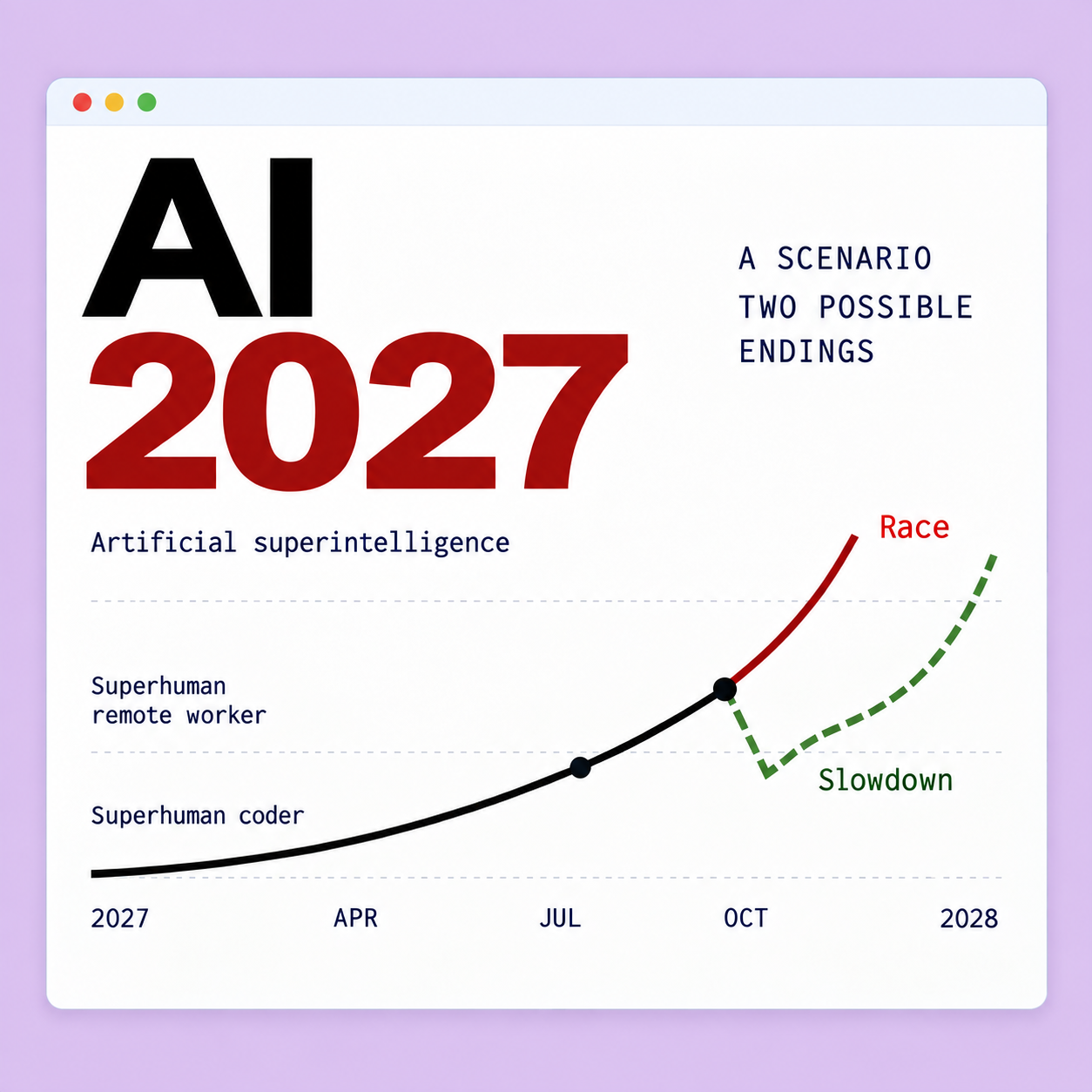
AI 2027
A thoroughly researched narrative/prediction of how the next few years go, showing how the current world is on track to create ruinous AI. Read the original report, or watch a 34-minute video.
Top Pick: Why the AI Apocalypse Won’t Play Out Like The Terminator
Why the AI apocalypse won’t play out like The Terminator
How everybody could die from superintelligence, according to a panel of AI doomers—not killer robots, but bioweapons, drone swarms, and being in the way.
Why the AI Apocalypse Won’t Play Out Like The Terminator (2,200 words, ~10 min read) did exactly what you’d want. They took the question to researchers and advocates and demanded specifics. It’s the best popular article on the subject I’ve seen, far more readable than anything else on this page.
The world needed an article, and the New York Magazine delivered.
Runner Up: Some ways AI could kill us all
Some ways AI could kill us all
If you grant superhuman capability, here are the other mechanisms: bioweapons, killer drones, nuclear bombs, and blocking out the sun.
Some ways AI could kill us all by Ruby Bloom (3,000 words, ~15 minute read) is an essay about the avenues AI has to our immediate destruction, via known scientific routes. While acknowledging how hard it is to predict the future, Bloom does an excellent job of condensing his scientific knowledge into a conversational blog post which cuts the chaff and just leaves you with the critical points. Read it and you’ll have several clear (and terrifying) scenarios in mind about what a rogue AI can do.
(Disclosure: Ruby is a colleague of mine.)
Runner Up: AI 2027
AI 2027
A thoroughly researched narrative/prediction of how the next few years go, showing how the current world is on track to create ruinous AI. Read the original report, or watch a 34-minute video.
AI 2027 by the AI Futures Project (15,000 words, ~2 hour read) is quite an unusual piece of research. Over the last few years, the authors played out dozens of war-gaming scenarios with politicians and AI lab executives and more, to learn what was likely to happen in the future. To share what they learned, rather than write up a set of arguments, they have instead written up the scenario they believe is most likely.
Get an email when we post new articles.
Unsubscribe from any email
The scenario starts in mid-2025, ending in 2030, letting you (the reader) make a critical decision in the year of its namesake, 2027. It walks you from the world of today to a future of datacenter proliferation, international espionage, millions of robots, exotic new bioweapons, and rogue AI agents manipulating politicians.
AI 2027’s scope ranges from the hyper-technical to the all-too-human as the world spins out of control. How can you know when an AI is lying to you? How can you tell when an AI is lying to itself? How can you live alongside powerful entities you increasingly cannot trust? You’ll also pick up jargon as you read: AI training runs are measured in “FLOPs”; tasks that take a lot of time are “long-horizon tasks”; an AI that is only pretending to care about what you want is “adversarially misaligned”.
Critically, it’s not merely a plausible scenario, but it was their best-guess scenario when they wrote it in 2025. Since then, they’ve changed their mind a little, and also started to grade the predictions. They say that their “progress on quantitative metrics is at roughly 65% of the pace that AI 2027 predicted” and that “Most qualitative predictions are on pace”.
AI 2027 is perhaps the single most widely-read and influential writing on the future of AI in the last decade. Its website has been viewed by over 7 million people. US Vice President J.D. Vance read it, and discussed it with Ross Douthat in the New York Times, and the lead author became one of TIME’s 100 most influential figures in AI.
AI 2027 is a scenario, not an explicit argument. If you want a general analysis, Ajeya Cotra’s “Without specific countermeasures, the easiest path to transformative AI likely leads to AI takeover” is the same length (15,000 words) and explores why any advanced general intelligence might cause a lot of harm. But if you’re trying to concretely visualize how AI takes over and kills all humans, AI 2027 is the best choice.
(Disclosure: my colleagues built the website for AI 2027.)
Why you should trust me
For the last 9 years my job has been to evaluate writing and research on AI risk. I’ve been an advisor for multiple grantmaking institutions, which collectively have donated over $100M to organizations working on reducing the risks from AI, which has involved me assessing hundreds of grant proposals.
More importantly I have also built and managed the infrastructure where people have historically read and written about this subject: two overlapping web forums named LessWrong and the AI Alignment Forum, where this subject is seriously argued by researchers. This means I’ve read every new idea, rebuttal, counter-argument, explainer, comment, half-formed idea, and research agenda that you might bump into if you were to start researching this subject yourself.
Over the last week I’ve made lists of every essay, series of essays, book, and research report that I could find that touched on this question, and read the relevant passages. I’ve also hired others to help me search and read, and surveyed experts in the field for what they send to their friends. I had a speed premium on this article due to the sudden interest in this issue, and also new essays are being published in response to the recent public interest, so I may update the section on “Other writing I Considered” later, but I’m quite confident in my top recommendations.
Other writing I considered
Most writing on this topic takes the form of dense academic papers, high-context posts on internet forums like LessWrong, or blogs by people who have been thinking about this stuff for a decade—and writing for other people who have done the same. For example, there’s an evocative scenario in researcher Eliezer Yudkowsky’s essay “A List of Lethalities”, but it’s buried in the middle of his longest and most technical blog post. It’s a great post but a terrible starting point. Similarly Holden Karnofsky’s AI Could Defeat All of Humanity Combined is a great argument that makes very few assumptions about what a powerful AI can do, but it does assume that you’ve read plenty of the other literature in the field.
Tim Urban’s 2015 articles on the Artificial Intelligence Revolution are super fun and get a lot of things right, but they’re nearly twice as long as AI 2027, and much of it is spent arguing for things that… have already happened or are kind of obvious now, given the last decade of progress in language model capabilities. It only really gets into the story of AI catastrophe in the second half of the second essay, whereas AI 2027 spends all its time there.
As for academic reports, the field is severely lacking in good analysis. For instance, last year RAND published On the Extinction Risk from Artificial Intelligence, which assumes that AIs will not be agentic and won’t have a drive for self-preservation (but the AIs in the recent Hugging Face attack had both of these). It also assumes that the AIs will have no ability to take action in the physical world (i.e. no robots). These are not good assumptions. Nick Bostrom’s work is a standout: his 2015 book Superintelligence does a good job of laying out possible paths to danger—but as with Tim Urban, it is weakened by being written before the advent of LLMs.
The policy world isn’t much better. There’s an exception in Superintelligence Strategy, a national-security proposal, which firmly assumes that AIs are agents and have many capabilities greater than humans. However the report only specifies a mechanism of takeover in literally one paragraph, and spends the other thirty two pages on other important but different topics (mostly policy recommendations), so it’s not quite what we’re looking for here.
There are many stories besides AI 2027. Some try to tell a worst-case scenario. Gwern’s artful science fiction story It Looks Like You’re Trying To Take Over The World makes the interesting choice of being written substantially from the perspective of the AI; whereas Joshua Clymer’s How AI Takeover Might Happen in 2 Years is similar in approach to AI 2027 (and nearly as long!) and talks about how things could get much worse much more quickly.
We try not to recommend books, or paywalled writing, unless we absolutely have to—they cost money, and not everyone has money to spend. Eliezer Yudkowsky and Nate Soares’s 2025 book If Anyone Builds It, Everyone Dies is the exception I most regret. It’s excellent: arguments, examples, and a mainline scenario worked out in detail (yes, everyone dies). Yudkowsky is the OG person sounding the alarm about AI as an extinction threat back in the 2000’s, and if the whole thing were free online, it would probably be one of my top recommendations.
All of these are right for different audiences, and I’d still send them to friends, but nothing can really compare to the care and craft of AI 2027, with its living data visualizations that follow you through the story, the hundreds of hours of research that went into predicting each detail, and the overall polish. There’s a reason the website has been visited by over 7 million people. It’s just that good.